Исаак Ньютон: от вопроса к «Принципиям» | 2025-06-03T03:01:26

Перечитываю сейчас A Short History of Nearly Everything by Bill Bryson. Старая книжка, 2003 года. Например, в ней автор радуется, что Плутон IAU наконец-то признали планетой. Так вот, там есть одна интересная история про научные стартапы 17 века.

Всем еще со школы известно, что Исаак Ньютон – отец классической механики и представлений о гравитации, и его перу принадлежит фундаментальный труд, на котором зиждется вся последующая физическая наука: «Математические начала натуральной философии», или попросту «Начала» (Principia).

Еще был Галлей — ну тот, в честь кого комету назвали, а еще был Гук, который открыл клетку (и закон Гука про деформации и кучу всего еще).

Так вот, в 1684 году Галлей, обсуждая с Робертом Гуком и Кристофером Реном проблему орбит планет, спросил: «Какая сила заставляет планеты двигаться по эллиптическим орбитам?» Гук утверждал, что это сила, обратно пропорциональная квадрату расстояния, но не мог это строго доказать. Галлей поехал в Кембридж к Ньютону, чтобы спросить его напрямую — и к своему изумлению, Ньютон сказал, что уже доказал это. Более того, он пообещал прислать подробное изложение. Собственно, он слегка заработался и вместо ответа на вопрос написал три тома «Начал» (причем написал еще специально сложно, чтобы непосвященные откидывались раньше).

Когда работа над «Началами» была почти завершена, Ньютон и Гук вступили в спор о первенстве в открытии закона обратного квадрата расстояния, и Ньютон отказался выпускать третий, ключевой том, без которого первые два тома теряли смысл. Только благодаря напряжённой дипломатии и самым щедрым дозам лести Галлею в конце концов удалось выпросить у капризного профессора заключительный том. Без интереса и подталкивания со стороны Галлея Ньютон, вероятно, не оформил бы свои открытия в виде цельного труда.

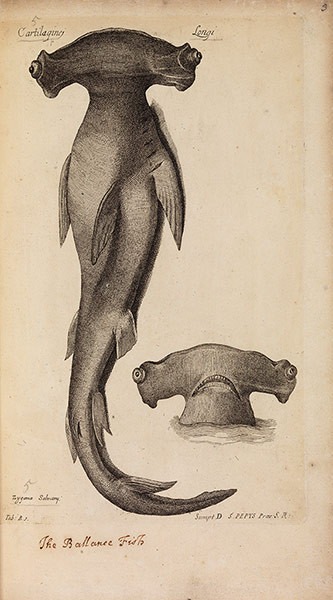
Королевское общество обещало издать труд, но затем отказалось, сославшись на финансовые затруднения. Годом ранее общество вложилось в дорогостоящий провал под названием «История рыб», и теперь заподозрило, что книга о математических принципах вряд ли вызовет ажиотаж на рынке.

Галлей, чье финансовое положение было скромным, оплатил издание книги из собственного кармана. Ньютон, как это было у него в привычке, не внес ничего. Чтобы усугубить ситуацию, Галлей как раз в это время принял должность клерка общества, и ему сообщили, что общество больше не может выплачивать ему обещанную зарплату в 50 фунтов в год.

Вместо этого решили платить экземплярами Истории рыб. Общество передало ему 50 экземпляров все той же «Истории рыб» (камин, по-видимому, ими предполагалось топить).

Было выпущено около несколько сотен экземпляров «Начал» – довольно большой тираж для такой дорогой книги, однако издание не вызвало ни малейшего интереса у читающей публики. Книга продавалась очень плохо, и ее издание не окупилось совершенно. Даже в 1739 году, через 53 года после издания, при инвентаризации за Обществом числилось еще 126 экземпляров, и это при том, что остальные продавались с огромными скидками, дарились и просто раздавались чуть ли не бесплатно.

Иронично, что один из самых влиятельных трудов в истории человечества в своё время считался практически коммерческим провалом.

А еще забавно, что с момента публикации, с 1687 года, в тексте была ошибка вычисления, которую в 1987 году, через 300 лет, заметил студент Роберт Гаристо, старшекурсник Чикагского университета.

В предложении восьмом (там в книге такая нумерация) Ньютон пытался подтвердить свою теорию, вычисляя массу, силу тяжести на поверхности и плотность известных планет. Для расчёта массы ему нужно было знать угол между прямой от центра Земли к Солнцу и прямой от точки на поверхности Земли к Солнцу.

Современные измерения дают это значение как около 8,8 секунд дуги (одна секунда — это 1/3600 градуса). Ньютон считал, что оно составляет 10,5 секунд, но загадочным образом в самом уравнении использовал 11 секунд. Именно эту ошибку обнаружил Гаристо, когда повторил вычисления в рамках обычного учебного задания.

Этот Роберт Гаристо сейчас редактор Physical Review Letters. Он относительно недавно прославился второй раз, когда его журнал опубликовал научную статью с 5154 авторами 🙂

Исследование рынка высокоценных книг на Amazon | 2025-05-31T01:45:23

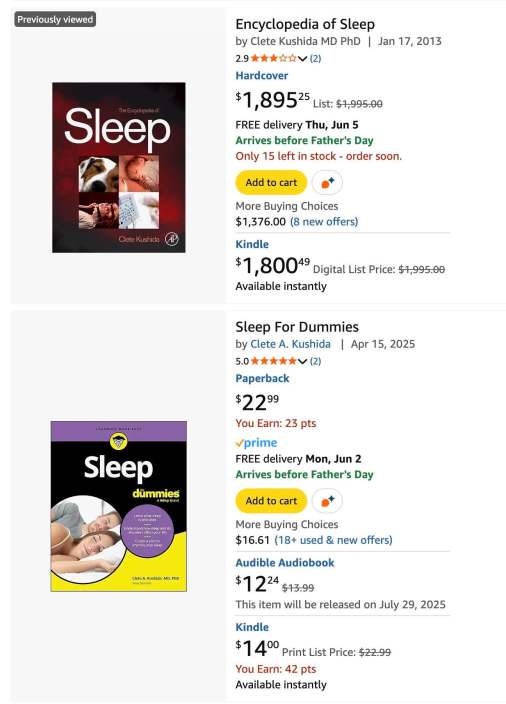
У Clete Kushida на Амазоне есть книжки «Sleep» за $1,895 и «Sleep для идиотов» за $22.99. Мне кажется, должно быть наоборот. У него есть еще «Encyclopedia of Sleep and Circadian Rhythms» за $2,247

Причем если поискать все книги на Амазоне и отсортировать их от самой дорогой к самой дешевой, то в топе будут книги за $200. Но если немного хакнуть систему и приписать в урл &low-price=…&high-price=…., то с сортировкой вниз по цене можно уже много что увидеть.

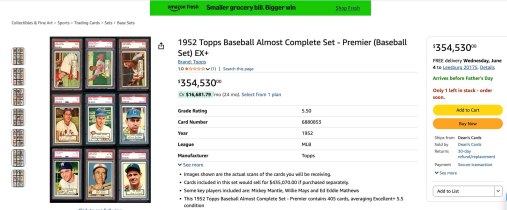
Я решил посмотреть, а что вообще продается за какие-то большие деньги на Амазоне. Например, Topps в листинге имеет набор бейсбольных карточек 1952 года «1952 Topps Baseball Almost Complete Set — Premier (Baseball Set) EX+» за $354,530. Единственный комментарий говорит «Damn I could take a picture and print those for free».

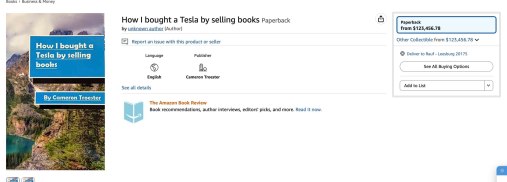
В основном за такие деньги идут бриллианты, сумки Hermes, и pre-fabricated houses. Интересно глянуть, а что в книжках. Разумеется, в топе антиквартиат, всякие ошибочно поставленные цены, и шутки.

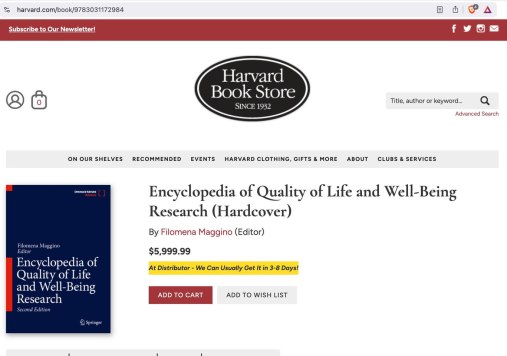
Но среди этого находятся реальные книжки за какие-то неразумные деньги. Например, Encyclopedia of Quality of Life and Well-Being Research By Filomena Maggino продается на Harvard Book Store за $5,999. Или вот Global Encyclopedia of Public Administration, Public Policy, and Governance 2nd ed. 2022 Edition by Ali Farazmand за $7,999.99. Вот интересно, продавать на цент ниже $8K себя оправдывает? На сайте springer электронная версия этой книги продается за $3500. А можно еще на пару месяцев взять в аренду на Kindle за $2000.

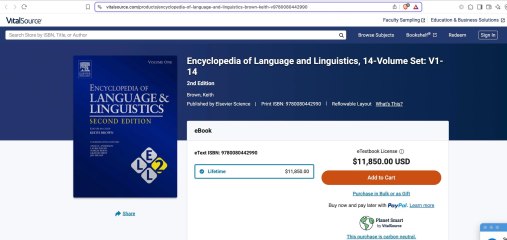
Или вот есть еще Encyclopedia of Language and Linguistics в 14 томах. На Амазоне у этой энциклопедии цена вообще под $100K, но очень легко найти другие сайты в сети, где продаются ее электронные версии. Как вы думаете, сколько может стоить электронная версия этой энциклопедии? Ценник везде в районе $11,000.

Из раритетных книг есть RECOVERY: THE HOSPITAL DRAWINGS OF ALFONSO OSSORIO. Интересно, что это просто книга, напечатанная относительно недавно, в 1995 году, тиражом 100 экземпляров, с индивидуальным номером. И вот сейчас эти книги продаются за 4-5 тысяч долларов. Ну с этим все понятно, это коллекционное.

Uncovered Treasures in the Garage: A Surprising Discovery from Yesteryear | 17 апреля 2024 года, 14:42

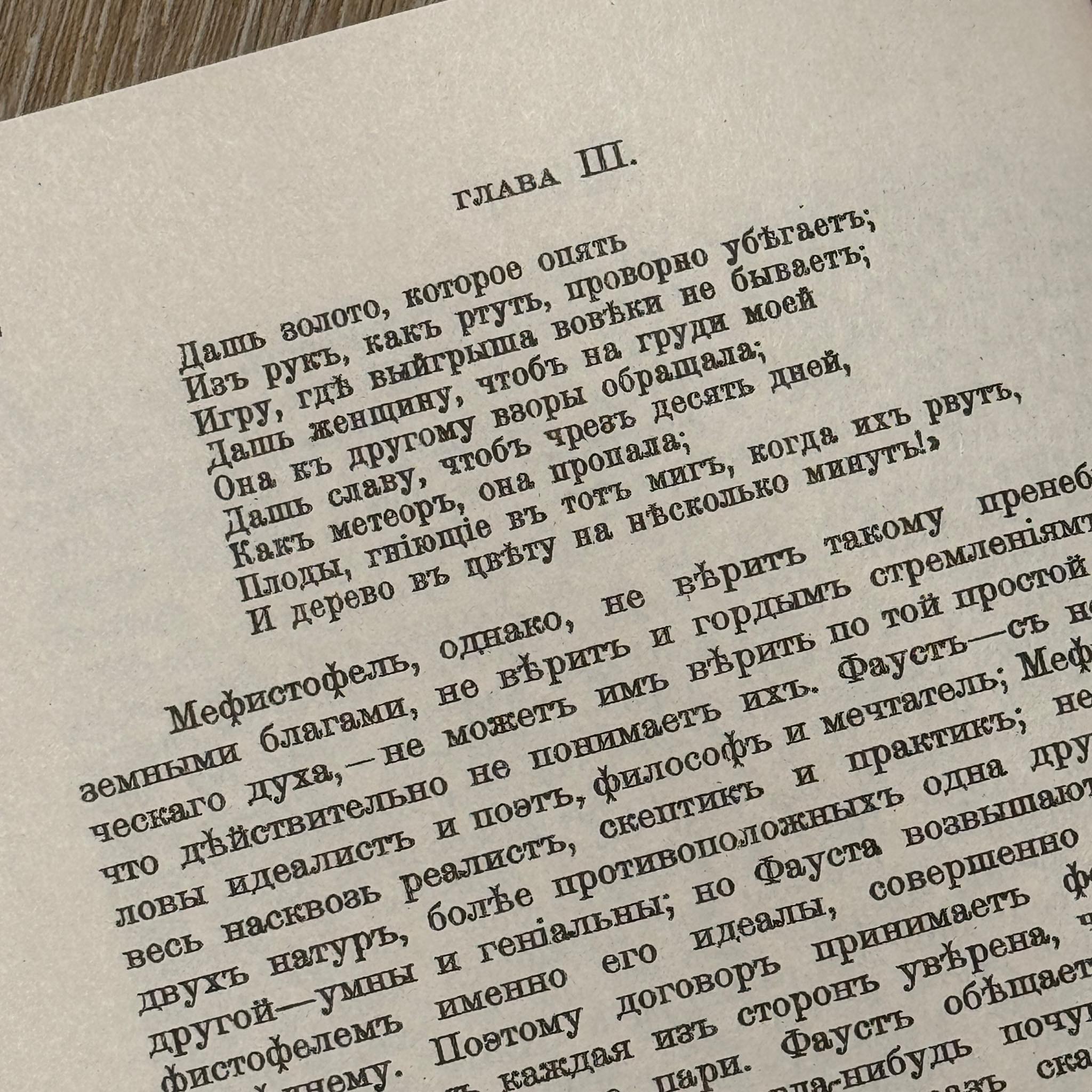
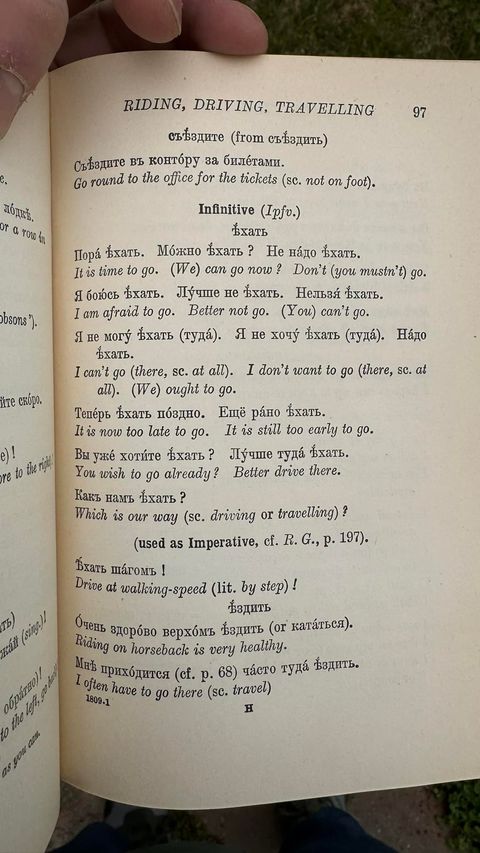
Разбирал гараж, нашёл учебник по русскому для англичан начала прошлого века. Постлать постелю, а потомъ можно ѣхать!

Бумага против экрана: от Netflix до книги | 15 апреля 2024 года, 22:24

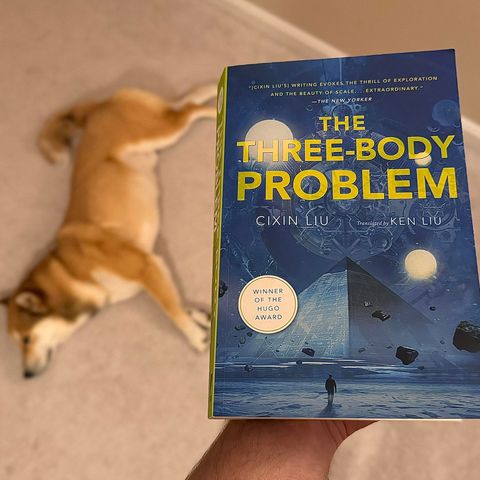
Есть кто-нибудь, кто читал? Я начал смотреть сериал на нетфликсе, но спустя несколько серий больше не мог выносить дикие упрощения в ущерб здравой логике, ну и остальные нетфликсоспецифичные штуки по чеклисту. Там Eiza Gonzalez хорошая, да, может норм причина глянуть пару серий. Не выдержал всего этого, перестал смотреть, заказал книжку. Прочитал четверть. Пока очень интересно — такая твёрдая научная фантастика, вполне в духе привычной от Азимова и Кларка. В книжке и близко нет ореола супергероев в стиле Марвел. Поначалу бросалось в глаза то, что перевод с китайского, и в итоге английский там странный. Как появилась эта мысль, стал внимательнее искать примеры, а их нет. То ли это начало было такое, то ли предрассудки. Ну еще посмотрим, 3/4 осталось. Если кто читал, скажите как вам (но не спойлирите). Это вообще трилогия, так что ещё два тома на очереди.

**The Unstoppable Rise of Numbers: A Growth Opportunity in the Making?** | 31 марта 2024 года, 13:06

Мне тут коллеги на одном из бизнес-митингов посоветовали книжку “Getting Naked: A Business Fable about Shedding the Three Fears That Sabotage Client Loyalty” и я ее через минуту купил не глядя. Эта книжка про различия между подходом к бизнесу и культурой больших традиционных консалтинговыми компаний-бегемотов и живых небольших стартапов, которые зачастую уделывают больших. Книжка в виде прозы, то есть, это и есть проза. Очень хорошо читается, не оторваться. В общем, я ее почти дочитал за три дня.

Так вот, я в процессе чтения делаю пометки карандашом на полях, когда встречаю интересные идиомы и идиоматические выражения. Но вместо того, чтобы перепечатывать сюда сами выражения – да и лень, я бы это просто не довел до конца бы – я просто выкачал из торрентов электрическую версию книжки, и вытащил оттуда идиомы с помощью AI. Они практически совпали с моими, ну и плюс есть несколько, которые я и так знал. Капсом идут названия глав, дальше идиомы. Вообще у меня это в гуглдокс есть, читать поудобнее, если кому надо – говорите, поделюсь ссылкой. Кстати, и книжку могу тоже прислать (epub).

ACCELERATION

“Blow-by-blow account” – This means a detailed description of every single action or event that happened, typically used to recount events with precision.

BRASS TACKS

Brass tacks – Getting down to the basic, essential details or facts.

DISCOVERY

The cat was already out of the bag – This idiom means that a secret has been revealed. It’s used here to indicate that the narrator’s reaction to the information had already disclosed their true feelings or thoughts.

Rubbing salt in the wounds – This idiom describes actions that make someone’s difficult situation even more painful or evident. In this case, the narrator feels that the comparison between the two firms emphasizes their own firm’s shortcomings.

Dumbfounded – Although not an idiom, this term is often used idiomatically to describe a state of being so amazed or shocked that one is unable to speak.

GASOLINE ON THE FIRE

“Gasoline on a fire” – This phrase means to make a situation worse or more intense.

“Reeling” – To be thrown off balance or feel dizzy, often used figuratively to describe being shocked, confused, or disoriented by a situation.

“Mob of angry townspeople with torches and pitchforks” – This is a vivid metaphorical expression used to describe a group of people who are very angry and looking to confront someone or something, much like scenes from stories where villagers hunt down something they fear or despise.

“Holding down the fort” – To take care of a place or maintain a situation in someone’s absence.

“Lay their torches and pitchforks down” – This metaphor suggests calming down or becoming less hostile, referencing the earlier metaphor of an angry mob.

“Keeping them within reach” – While not strictly an idiom, this phrase is used figuratively here to imply that the attendees were still ready to become hostile again if necessary.

BACKLASH

“chickened out” – This means to avoid doing something because of fear or anxiety.

“want to chicken out myself” – Similar to the first, expressing a desire to avoid doing something due to fear or apprehension.

“calm and unruffled” – Describes someone who remains composed and not visibly upset by what’s happening around them.

“hammer all this out” – To discuss and come to an agreement on all details or issues.

“back down” – To withdraw a claim, demand, or commitment, often in a conflict or competition (“And even though I knew they would hate the idea, I wasn’t going to back down.”).

DEBRIEF

Milking the drama – Drawing out a situation for emotional effect or to gain sympathy, attention, or other benefits

Off to a rocky start – Beginning with difficulties or challenges, suggesting that the initial phase was not smooth or successful (“And I didn’t like the idea of having Jim Kendrick involved, not this early in a process that was already off to a predictably rocky start.”)

TELL

“To hell with it” – An expression used to show disregard or indifference towards a situation or outcome.

“Worked my way up the ladder” – A metaphor for gradually advancing in one’s job or career.

“Being a little too cute” – An expression criticizing someone’s attempt to appear endearing or clever in a way that seems insincere or overdone (“This was all just a little too cute for me, so I moved the conversation along”)

“Geezers” – A colloquial term, often used humorously, to refer to older people.

“Made him an offer he couldn’t refuse” – An idiom popularized by “The Godfather” movie, meaning to make such a good offer that the person cannot decline, or implying a threat if the offer is declined.

“Pulled the trigger on this deal” – An idiomatic expression meaning to finalize or commit to a deal or decision.

RECOVERY

a push – An idiom that means a period or instance of exerting effort or endeavoring hard in preparation or accomplishing something (“The next day was a push as I prepared for my temporary move to Half Moon Bay. “).

a wash – An idiom used to describe a situation that has neither positive nor negative consequences; it balances out (“From a transportation standpoint it would be a wash, as I lived near the San Francisco Air port and would be doing a reverse commute. “)

braced for – To prepare oneself emotionally or physically for something difficult or unpleasant that is about to happen (” But in every other way I braced for what I was sure would be a major transition.”)

riding on my ability to.. – An idiom that means depending on something for success or failure (“All of a sudden my career seems to be riding on my ability to deal with a bunch of people who look like they should be working at the Gap.””).

dove back into – An idiomatic expression that means to start or continue doing something with enthusiasm or intensity, often after a brief interruption.

REENTRY

“a far cry from” – This is an idiom meaning something is very different from something else.

“rolled around” – This could be considered idiomatic, suggesting that time has passed and a particular moment has arrived (“By the time our nine-thirty meeting rolled around, I was glad for something real to do.”)

“fire away” – An idiom meaning “start or proceed with expressing your thoughts or questions.”

“deep pockets” – An idiom referring to substantial financial resources.

“take a flyer on us” – This is an idiomatic expression meaning to take a chance or gamble on something uncertain.

ADVICE

“throw me under the bus” – This idiom means to sacrifice someone or betray them, especially to avoid trouble for oneself. It suggests leaving someone else to take the blame or suffer the consequences.

“flamed out” – To fail in a dramatic or notable way. Originally used to describe a jet engine failing by suddenly extinguishing, it’s used metaphorically here to describe a significant professional or personal failure.

EXPOSURE THERAPY

“Thrown for a loop” – Surprised, confused, or thrown off balance.

“Low-hanging fruit” – Tasks, actions, or goals that can be easily achieved without much effort.

“Rerun the numbers” – To recalculate or re-evaluate something, often financial figures or data.

“On the ground” – In reality or practical terms; often used to distinguish between theoretical or abstract ideas and their real-world implications or outcomes.

“Wrapped things up” – To finish or conclude something, especially a task or activity.

“Finding joy in suffering and trial” – An expression suggesting that positive outcomes or personal growth can emerge from difficult or challenging experiences.

“High-fiving each other” – A gesture of celebration or agreement, indicating mutual satisfaction or success.

CONSISTENCY

“Play it cool” – Behave in a calm, controlled way, especially in a difficult situation.

“Rearranging deck chairs on the Titanic” – Making superficial or futile changes in a situation that is already doomed to fail.

SPEED READING

“a structure guy” – someone who prefers organization and clear frameworks.

“head was spinning” – feeling confused or overwhelmed (“Combine that with a bunch of new medical terms and more three-letter acronyms than I could possibly remember, and my head was spinning.”).

“scratching my head” – puzzled or confused.

“lost in the depth” – deeply confused or not understanding the complexity (“I figured I was the only one in the room lost in the depth of the conversations.”)

“off base” – incorrect or inappropriate (“She was surprised at first that her suggestion was so off base, but then she seemed to shrug it off almost immediately.”).

“shrug it off” – to ignore or dismiss something as unimportant.

“hot seat” – a position of intense scrutiny or pressure (“Amy was off the hot seat—not that she ever looked like she was sitting on it in the first place.”)

DANGER

“a real buzz kill” – Something or someone that dampens the mood or ruins the atmosphere (“But when you approach every issue with such …,” she searched for the right word, “negativity, it’s a real buzz kill for the team.”).

“reached a completely new level of silence” – Hyperbolically describes an intense silence that is even more profound than usual, often due to anticipation or shock.

“everything is always someone else’s problem” – Describes a tendency to blame others and avoid taking responsibility.

“tapping into the technology” – An idiom meaning to utilize or make the most of available technology (“Do you think we’re going to come anywhere close to tapping into the technology that you’ve put together if we keep wasting time and energy like this?””)

“a pain in the ass” – A vulgar idiom used to describe someone or something that is very annoying or troublesome.

“pissing you off” – A colloquial and slightly vulgar way of saying making someone angry.

DIGESTION

“a blur” – This means something is unclear or forgotten, often because it happened very fast or was not fully understood (“The rest of the session was pretty much a blur for me, as I tried to process what I had been witnessing, not only that day but during my first few weeks at Lighthouse.”)

“throw up all over the plan” – This is an idiomatic way of saying someone strongly rejected or criticized the plan.

“hanging him out to dry” – To leave someone in a vulnerable position without support (“Heck, we figured Michael would want to walk away from a client for hanging him out to dry like that.””)

“trial balloon” – A test to see how a new idea or suggestion will be received.

“taking one for the team” – To suffer or undertake a negative experience or penalty for the benefit of the group or team (““Well, the next time Michael met with the executives, they teased him about taking one for the team.”)

COUNSEL

“way out on the horizon” – Something that is a long way off in the future; not an immediate concern.

“seeing around corners” – To anticipate or predict future events or problems.

“the acquisition will tank” – The purchase will fail disastrously (“Marty is going to buy into whatever it is that I’m learning here. He’d never want to work with these people, which means the acquisition will tank, I’ll get tossed aside, my career will get thrown for a loop and …” I paused, which gave Diane the opportunity she needed.”)

“get tossed aside” – To be rejected or discarded.

“thrown for a loop” – To be surprised or confused so much that one does not know how to react.

“there’s nothing to fear but fear itself” – A famous quote implying that fear is the only thing people should be afraid of, as it can paralyze more than actual dangers.

“What doesn’t kill you makes you stronger” – Experiencing adversity ultimately makes one more resilient.

“let the chips fall” – To let things happen as they will without trying to control them.

“bring out the big guns” – To use one’s most powerful or effective resources or arguments.

“speak your mind” – To say what one really thinks.

ENDURANCE

“in the dark” – Not informed or aware of something (“to keep him in the dark about what I was really thinking.”).

“pushed him off” – Delayed or postponed dealing with someone or something.

“about as popular as” – A comparative expression used to indicate something is likely to be unfavorably received (“I decided that talking to Marty and Jim Kendrick and the other partners about culture would be about as popular as leading them in a session of hot box yoga”).

TEST RUN

low-hanging fruit – Refers to tasks, actions, or goals that can be easily achieved or obtained with minimal effort.

holed up – To seclude oneself in a particular place for a period of time (“The hospital CEO, Michelle Thomas, introduced me to the handful of executives who would be holed up in the third-floor conference room for the next nine hours. “)

sized up – To assess or evaluate someone or something (“I had already sized up the room and decided that the group probably had never made a decision like this before..”).

coming to terms with – Accepting and dealing with a difficult situation (“…but coming to terms with the idea of not building the satellite facility, and possibly not growing at all.”)

stick to – To continue doing something, or to limit oneself to a particular activity or subject.

doesn’t add up – Something that does not make sense or seems illogical (“Something just doesn’t add up here.”)

SWALLOWING MEDICINE

salvage the day – To recover or make the best of a situation that has gone wrong (“But I think we can salvage the day and still arrive at the right decision before midnight.”)

buying us dinner – An idiomatic way of acknowledging a debt or obligation, in this case, humorous reparation for a mistake (“Then you’re going to be buying us dinner, too.”)

What does your gut tell you – Asking for an intuitive or instinctive feeling about something, rather than a thought-out analysis.(“My gut tells me that if you really think your occupancy numbers are going to continue growing and that the economic development in this area is not a fluke, expansion probably makes sense.)

not a fluke – Something that is not happening by chance or accident but has a solid reason behind it.

TRIAL

“Behind enemy lines”: While not used as a traditional idiom in this context, this phrase metaphorically describes the protagonist’s venture into a challenging and unfamiliar territory within the professional setting. It’s akin to an idiomatic expression by using a typically military term to describe a business situation, suggesting a deep immersion into a potentially hostile environment to gain insight or achieve a specific objective.

“Naked and Vulnerable”: This recurring theme is not an idiom but serves as a powerful metaphor throughout the narrative. It symbolizes transparency, honesty, and the courage to be seen without pretenses in a professional context. The concept is used idiomatically to represent a set of behaviors that foster trust and authenticity.

“Throw under the bus”: This is a classic idiom that appears in the narrative, symbolizing betrayal or sacrificing someone else’s interests for one’s own gain. It’s used to describe actions within the corporate maneuvering and politics that the protagonist experiences.

“Wearing multiple hats”, “Taking the heat”, and “Rolling up sleeves”: These phrases, while not explicitly mentioned in your narrative, are examples of idiomatic expressions that might align with the themes of versatility, accountability, and readiness to work hard, which resonate with the challenges and dynamics described in your story.

“Turning the tables” and “A change of heart”: These idioms metaphorically describe significant shifts in perspective or behavior, akin to what the protagonist and other characters experience as the narrative unfolds. The story explores transformations in professional identities and strategies, aligning with the essence of these idioms.

“Crossroads” and “At a loss”: Reflecting moments of decision or confusion, these idiomatic expressions capture the essence of the protagonist’s journey through uncertainty towards a clearer sense of purpose and direction.

OFFENSE

“Let ’em have it!” – Slang for attacking or giving someone a piece of your mind; to tell someone something very directly or give them something with full force.

“Opted for somewhere in between” – Choosing a moderate or middle course of action.

“At least for the time being” – For now; a phrase indicating a temporary situation.

“Sitting in an ejector seat” – Metaphorically indicating being in a situation where one could be suddenly and forcefully removed.

“Going for broke” – Risking everything in the hope of having a significant success.

“Wasn’t buying it” – Not believing what someone is saying.

NO HOLDS BARRED

No holds barred – This phrase indicates a situation where there are no restrictions or limitations on how something is pursued or handled.

Sugarcoat – To make something unpleasant seem more palatable or acceptable by presenting it in a more favorable way.

Straight from the horse’s mouth – To hear something from the most direct or authoritative source (implied by the context of wanting direct honesty without intermediaries).

I have some swampland to sell you – An expression used to indicate that something is a deceit or a scam, suggesting skepticism about the truthfulness of a statement.

SUCKER PUNCH

Sucker Punch – An unexpected or unprovoked attack, usually in a context where such actions are metaphorical, relating to a surprising or deceitful act.

Got the bloodletting started – Initiate a process of reduction or elimination, often in a brutal or ruthless manner. Originally referring to an ancient medical practice, used here metaphorically to indicate the start of a confrontational or challenging process.

Behind enemy lines – To be in a position or situation where one is surrounded by adversaries or in a hostile environment. It’s used metaphorically to describe working in or dealing with a challenging or competitive situation.

DELIBERATION

“Feeling like a prisoner getting ready for the gallows” – An idiom used to describe feeling doomed or resigned to a negative fate, with “the gallows” metaphorically representing impending doom or punishment.

CROSS EXAMINATION

In a place of quiet confidence – Feeling assured and calm without the need for outward bravado. Describes the narrator’s sudden shift to feeling confident despite the situation (” Normally that would have been awkward, but suddenly I was in a place of quiet confidence, where awkward didn’t seem to matter.”)

Pat me on the head – A condescending gesture that suggests treating someone as a child or in a diminutive manner (” Like she was proud of me, and wanted to reach down and pat me on the head.)

Jumped a few notches – An increase in level or intensity (“I could tell my audience’s interest in what I was saying jumped a few notches.”)

Shift into defense mode – To become defensive or protective in anticipation of criticism or attack.

Власть Красоты: Как наше подсознание связывает внешнюю привлекательность с внутренней достоинством? | 25 октября 2023 года, 08:12

продолжаю читать Determined

Cапольского. Интересное (перевожу на русский)

«…На протяжении тысячелетий мудрецы утверждали, что внешняя красота отражает внутреннюю доброту. Хотя мы больше не заявляем об этом открыто, красота все еще властна в нашем подсознании; привлекательных людей считают более честными, умными и компетентными; их чаще выбирают или нанимают, и с более высокой зарплатой; они реже становятся виновниками преступлений и получают более короткие сроки. Боже мой, не может ли мозг различать красоту от доброты? Особенно не может. В трех разных исследованиях участники в сканерах мозга чередовались между оценкой красоты чего-то (например, лиц) или доброты какого-либо поведения. Оба типа оценок активировали одну и ту же область (орбитофронтальную кору или OFC); чем красивее или лучше, тем больше активации OFC (и меньше активации инсулы). Будто бы несущественные эмоции о красоте мешают мозговому размышлению о мерах справедливости. Что было показано в другом исследовании – моральные суждения больше не окрашивались эстетикой после временного подавления части PFC, которая направляет информацию об эмоциях во фронтальную кору.»

А для вас красивые люди ассоциируются с честностью, умом, и добротой?

В пустоте исторических страниц | 13 августа 2023 года, 09:44

смотрю на новый учебник истории для 11 класса. Интересный артефакт. Нашел 415 страницу, в которой есть три абзаца, к которым даже нет вопросов. Именно так все и будет.

Music to My Ears: The Surprising Story of EMIs True Purpose | 28 мая 2023 года, 11:50

Что сегодня вычитал интересного:

Вы точно слышали про EMI ,это лейбл, издавший сначала Битлс, а потом ещё тучу громких имён. Но оказалось, что музыка для них была одной из мелких экспериментальных ниш. Оказалось, что EMI с 1937 года являлась крупным (практически, монопольным) подрядчиком военно-промышленного комплекса Великобритании в части разработки и производства взрывателей и детонационных цепей для всех категорий боеприпасов (снарядов, мин, авиабомб и др.), предохранительно-исполнительных механизмов ракетного вооружения и других электрических и электромеханических изделий военного предназначения, а также радиолокационных средств. И это был основной бизнес. А музыка – так, для разнообразия.

Также интересно, что благодаря битлам — часть дохода с продаж была направлена на экспериментальный проект Годфри Хаунсфильда, руководителя проекта — появился первый в мире компьютерный томограф. Тот томограф даже поначалу назывался EMI scanner.

Кстати, в США аналогом EMI была компания General Electric, которую большинство знает по лампочкам. Та, что основана Томасом Эдисоном. Например, они изобрели первый турбореактивный двигатель и первый рентгеновский аппарат и первый МРТ (хотя в случае МРТ англичане одновременно сделали свою версию). Например, их двигатели используются в ПВО Patriot, есть целая серия ЗРК разработанных с нуля, гусеничная техника и т.д.

Про МРТ ещё интересно – слово ядерный из определения магнитной резонансного томографа убрали после аварии в Чернобыле, чтобы не создавались неверные коннотации

Дочитал! | 30 сентября 2022 года, 18:37

Дочитал! Как и все предыдущие книги, вслух (я надеюсь, так чувство языка укрепится ещё больше – эксперимент ещё продолжается). В общей сложности, на чтение вслух ушло 15 часов.

Книга — шикарная. Для всех стартаперов — прямо must read. Книга “отца iPod и Nest” написана как очень конкретное и честное руководство по тому, как «делать то, что стоит делать». Куча ценных советов по построению всего: от себя и своей карьеры до продуктов, команд и бизнеса.

https://www.goodreads.com/book/show/59696349-build