
Reading “Life’s edge”. I liked Carl Zimmer’s “She Has Her Mother’s Laugh: The Powers, Perversions, and Potential of Heredity” and could not stop myself from buying his new work. As the book’s name says, “Life’s edge” is about what life is, and why scientists have struggled to draw its boundaries.
(Side note… I bought this book after returning another one, which appeared to be not interesting. It turned out that books are returnable in Barnes and Noble, 30 days after the purchase)
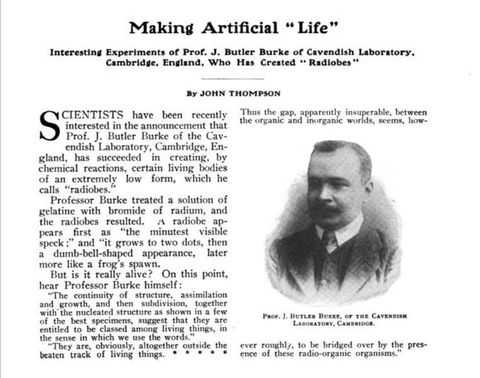
So, what I want to say is… there is an interesting story with which the book begins. That story is about John Butler Burke, a physicist at the Cavendish Laboratory at the University of Cambridge, who performed experiments in which he introduced a radium salt into the sterilized beef broth. The result was the creation of lifelike forms that he called radiobes. These radiobes started out as small spots, some less than a micrometer across and barely visible under Burke’s microscope. These spots gradually grew and changed shape over a period of a few days, developing internal structures that made them resemble bacteria. Burke came to believe that these forms were not quite alive but existed somewhere on the border of living and nonliving. They were perhaps evidence of an ancestor to life, one that predated the earliest life forms.
That was happening in far 1904. Interesting that his theory had surged in popularity so that he quickly stopped continuing his research and instead he started giving public lectures which helped to monetize his popularity.
Excited newspaper headlines were proclaiming that Burke had found the “Secret of Life,” but skepticism from scientists came quickly. Another Cavendish-trained physicist, W. A. Douglas Rudge, repeated the experiment and concluded that the radiobes were sulfate precipitates and therefore purely physical. By the time Burke published a book in 1906 summarizing his work, he was widely dismissed as a physicist with a weak knowledge of biology.
Interesting that both Burke’s radiobes and Burke himself have not earned even a Wikipedia page. The story of radiobes is hardly covered on the Internet. While Burke went wrong, he did so in an attempt to make sense of life itself, and it is quite surprising for me to see him virtually unmentioned.
A link to his book is in the comments.

 Being in America