
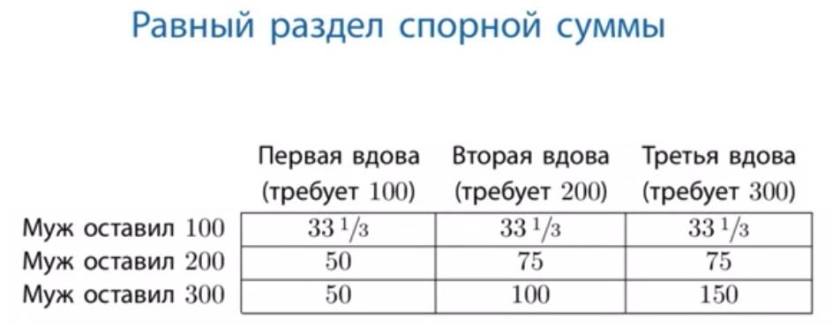
I learned an interesting example from the game theory. A man dies, leaving debts totalling more than his estate. should the estate be divided among the creditors? Let’s take three wives, the debts are 100, 200, and 300. And there are three cases corresponding to estates of 100, 200,
and 300. The hebrew’s Mishna stipulates the divisions shown in the picture attached to this post, and this solution is very interesting. For 100, it is an equal division: each wife will get 33 1/3. For 300, it is an proportional divison, first one will get 50, second wil take 100, and the third will receive 150. But what is for the second case? (50, 75, 75)?
Auman and Mashler found a solution via pre-nucleolus. Of course, Tora doesn’t say about that. However, it has an interesting principle of divisions illustrated by another Mishna, “Two hold a garment; one claims it all, the other claims half. Then the one is awarded 3/4, the other 1/4.”. The principle is clear. The lesser claimant concedes half the garment to the greater one. It is only the remaining half that is at issue; this remaining half is therefore divided equally. Note that this is quite different from proportional division.
Your claim is 100, right? Take 50 and go.
By the way, it is a great tactics for bargaining or business negotiations: try to ask more than you expect to get without
a fight.
It explains 50/75/75 in the second line of the table attached. Each wife requires 100 at least, and the estate costs 100 too, so for this case, an equal division works well. If the estate costs 200, first wife gets 50% of what she claims, and other wives will receive the same amount at least, totally 50+50+50=150. We have 200, so 200-150 will be split between wives. Not equally, first 25 is a half of (50% of what she claims, 0.5*200=100) and (what she get, it is 50), that is 75. The third wife takes 75 too, as a reminder.
The third case, 300, has the same logic. If you give all 100 to the first wife, it is unfair, because 2nd and 3rd won’t take their 200 and 300. So first wive will take 50, all other will take 50 as well, totally 150. The reminder is 300-150=150. The second wife wants 200, the half of this is 100, and she has already received 50. If we add 50 to the first 50, we’ll give 100 to her, which is 50% of what she expects, and the reminder will go to the third wife.
The detailed paper is here: http://www.cs.cmu.edu/~arielpro/15896s15/docs/paper8.pdf
 Being in America